Nation Discovers Economy Is Just Three Landlords in a Trench Coat Guarding a Permit Office
By
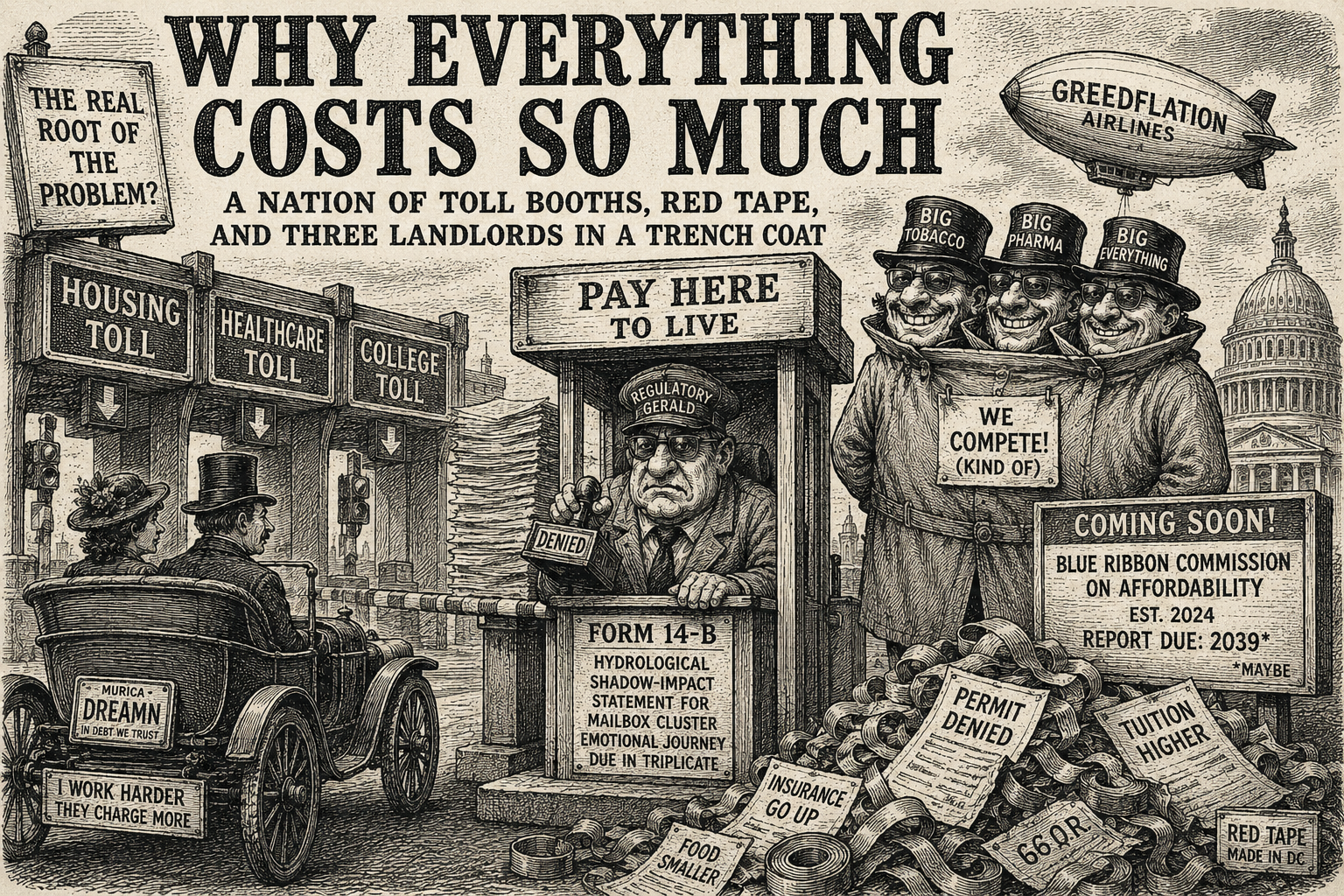
There comes a moment in every great civilization when the citizens gather around the sacred checkout scanner, watch a bag of groceries ring up at the price of a used kayak, and whisper the ancient democratic prayer:
“What the hell happened?”
For years, Americans have been told that prices are high because of inflation, supply chains, greedy corporations, tariffs, regulations, wages, interest rates, overseas labor, college costs, housing shortages, food costs, energy costs, and possibly that one guy at the zoning meeting who starts every sentence with, “As a longtime resident.”
Naturally, this has left the public confused.
Thankfully, after extensive research, careful economic analysis, and repeatedly refreshing Zillow until the soul left the body, experts have identified the root cause:
Everything important in life has been converted into a toll booth.
Housing?
Toll booth.
Healthcare?
Toll booth with Latin paperwork.
College?
Toll booth with a mascot.
Food?
Toll booth with seasonal branding.
Insurance?
Toll booth that can legally deny having a toll booth.
Employment?
Toll booth operated by a software platform that rejected your résumé because your font lacked sufficient leadership potential.
And standing proudly beside every toll booth is America’s most beloved mascot: Regulatory Gerald, the clipboard-wielding goblin of procedural delay.
“We have determined that your application to build twelve affordable townhomes is incomplete because Section 14-B requires a hydrological shadow-impact statement on how the proposed mailbox cluster may affect the emotional journey of nearby ornamental shrubs.”
This, of course, is called responsible governance.
Not to be confused with corruption, regulatory capture, bureaucratic molasses, or the ancient art of making sure only companies with seventeen attorneys and a lobbyist named Chase can afford to compete.
The Housing Shortage That Everyone Can See Except the Committee Studying It
The housing market is perhaps the finest exhibit in the Museum of National Self-Sabotage.
The country needs more homes, but communities have heroically responded by allowing exactly three new units, provided they are invisible from the road, built entirely from reclaimed moral superiority, and include seventeen parking spaces per bedroom.
Developers say they would build more housing if approvals were faster.
Local boards say they would approve more housing if developers respected “neighborhood character.”
Homeowners say they support affordable housing deeply, spiritually, and with great compassion, as long as it is constructed somewhere else, preferably in a zip code visible only by satellite.
Meanwhile, younger buyers have been invited to participate in the American Dream by purchasing a charming starter home listed at $487,000, featuring two bedrooms, one bath, a haunted crawlspace, and the original 1973 electrical panel still powered by optimism.
But fear not.
The solution is coming.
A Blue Ribbon Commission on Housing Affordability has been formed to study the findings of the previous Blue Ribbon Commission, which reviewed the recommendations of the Special Task Force, which was convened after the Emergency Listening Session, which produced a 214-page report titled:
Possibly Allowing Duplexes Near a Bus Stop: A Framework for Courage.
The report is expected to be reviewed in 2039.
Groceries: Now Available in Smaller Packages With Larger Lies
Food costs are another mystery, at least to anyone who has never noticed that our food system is held together by diesel fuel, weather, fertilizer, underpaid labor, refrigerated trucks, corporate concentration, and the fragile mood of the chicken supply.
The modern grocery aisle now offers consumers a thrilling choice between:
- “Family size”
- “Value size”
- “Mega size”
- “Party size”
- “Technically smaller than last year but wearing a bolder font”
This innovation is known as shrinkflation, a practice in which companies reduce the amount of product while maintaining the price, allowing shoppers to experience the miracle of paying more for less without the inconvenience of being told directly.
It is not greed, executives explain.
It is “margin preservation.”
This is business language for:
“The yacht has a second yacht.”
Of course, not every price increase is corporate villainy.
Sometimes fuel really does cost more.
Sometimes fertilizer really does spike.
Sometimes weather really does wreck crops.
Sometimes labor, packaging, transportation, disease, and global instability all pile into the same shopping cart and scream.
But sometimes a company raises prices because everyone else is raising prices, consumers are already dazed, and the earnings call needs a little sparkle.
That is not inflation.
That is inflation wearing a fake mustache and asking for a bonus.
Tariffs: The National Sales Tax Wearing a Hard Hat
Then there are tariffs, the economic equivalent of placing a mousetrap in your own shoe to teach the mouse a lesson.
Tariffs can protect certain industries, sometimes, briefly, under very specific conditions, assuming no one needs imported parts, affordable materials, functional supply chains, or pants.
Politicians love tariffs because they sound muscular.
They pound the podium and declare that foreign countries will finally pay.
Then consumers pay.
Then manufacturers pay more for inputs.
Then companies raise prices.
Then everyone argues on television until a man in a flag pin says the word “China” like he just discovered thunder.
To be clear, tariffs are not always useless.
Used carefully, they can protect strategic industries.
Used carelessly, they become a national sales tax wearing a hard hat.
And America has developed a worrying habit of confusing the two.
A tariff may help protect a steel plant, but if it makes appliances, cars, construction, machinery, and repair parts more expensive, the policy starts to look less like industrial strategy and more like economic whack-a-mole with a patriotic mallet.
Why Wages Forgot How to Climb Stairs
Which brings us to overseas labor, the ghost haunting every wage negotiation.
For decades, workers were told that productivity would make everyone richer.
And it did.
Just not everyone.
Productivity climbed the ladder.
Wages got stuck in the basement with a pizza party and a quarterly engagement survey.
Companies discovered that jobs could be outsourced, automated, contracted, franchised, fissured, platformed, and otherwise minced into little cost-saving cubes.
Workers were told to reskill.
Then upskill.
Then cross-skill.
Then network.
Then brand themselves.
Then accept that the job now requires a master’s degree, five years of experience, three certifications, weekend availability, and the emotional resilience of a lighthouse.
America did not lose the ability to give raises.
It lost the habit.
Raises used to come from bargaining power, job switching, unions, internal promotion, and companies that still believed workers were part of the enterprise instead of replaceable meat peripherals attached to a login.
Now many workers negotiate alone against corporations with human resources departments, legal teams, market analytics, compensation bands, productivity dashboards, and the spiritual warmth of an airport kiosk.
Then executives act surprised when people become cynical.
College: The Toll Booth With a Mascot
And college?
College looked upon this chaos and said:
“What if we charged eighteen-year-olds the price of a condominium for access to a PDF and a parking crisis?”
Universities became luxury credential factories where students borrow enormous sums to obtain degrees required by jobs that used to train people internally.
This is called opportunity.
Also indenture with school colors.
A generation was told college was the golden ticket.
Then the ticket was financed at interest, the chocolate factory outsourced the Oompa Loompas, and the hiring manager started asking whether the applicant had “real-world experience.”
To be fair, college is still worth it for many fields.
Doctors, nurses, engineers, accountants, researchers, teachers, lawyers, architects, and technical specialists generally need structured education.
But too many degrees have become expensive permission slips for jobs that mostly require training, judgment, reliability, and the ability to survive Microsoft Teams.
The problem is not education.
Education is good.
The problem is debt-backed credential inflation, where the country keeps moving the starting line farther away and charging admission to approach it.
Regulation: The Safety Net That Became a Spider Web
This is where the shouting usually begins.
One side says regulation protects people.
The other side says regulation strangles everything.
Both are right, which is inconvenient and therefore rarely allowed on television.
Building codes exist because buildings collapsed, burned, flooded, poisoned people, and occasionally tried to become pancakes during storms.
Food safety rules exist because companies have sold contaminated food with the moral confidence of raccoons in a dumpster.
Drug regulations exist because “trust us” is not a medical testing protocol.
Financial regulations exist because banks, left alone too long, sometimes reinvent fraud and call it innovation.
So no, the answer is not to delete every rule and let the market sort it out with lawsuits, funerals, and documentary footage.
But regulation becomes rotten when it stops protecting the public and starts protecting incumbents.
That happens when rules become so expensive, complicated, slow, and lawyer-soaked that only giant companies can comply.
A billion-dollar corporation sees a compliance maze and hires a department.
A small business sees the same maze and dies quietly behind the printer.
That is regulatory capture’s finest trick:
Make the rule sound noble.
Make the process impossible.
Watch the giants survive.
Call the result “market consolidation.”
Vaping, Tobacco, and the Velvet Rope of Compliance
Consider vaping.
Public health officials say flavored vapes attract young people.
That concern is real.
Nicotine companies have a long and ugly history of marketing addiction with bright colors and fresh breath.
But then the regulatory system arrives with a process so expensive and technical that small vape companies struggle to survive, while Big Tobacco and major nicotine companies can afford the lawyers, scientists, applications, lobbyists, consultants, and regulatory patience required to stay in the game.
The result is beautifully absurd.
A rule intended to protect the public can also wipe out small competitors and leave the market to the largest nicotine companies on Earth.
This does not mean every vape restriction is secretly written in a smoky back room by men named Brent.
It means complicated regulation often creates a velvet rope.
The public is told the rope is for safety.
Sometimes it is.
But it also determines who gets into the club.
The Real Root: Essentials Became Toll Roads
So what is the real cause of the cost-of-living crisis?
It is not one thing.
It is the grim little alliance of many things:
- Housing scarcity
- Slow permitting
- Corporate concentration
- Weak worker bargaining power
- Tariffs used without strategy
- College credential inflation
- Healthcare and insurance complexity
- Food-system fragility
- Energy volatility
- Regulatory capture
- Local veto power
- Global labor pressure
- Financialization of basic life
That is why the problem feels so maddening.
A TV got cheaper because global manufacturing, automation, competition, and productivity did their job.
A house got more expensive because land, zoning, financing, insurance, labor, materials, investors, and local politics formed a conga line of obstruction.
A computer got better and cheaper.
A college degree got more expensive and somehow more mandatory.
A phone became a miracle slab of glass.
A doctor’s bill became a cursed scroll.
The American economy did not simply inflate.
It split.
The things exposed to competition and technology became cheap confetti.
The things protected by geography, bureaucracy, market concentration, and credential systems became toll roads.
The Fix, Assuming We Are Still Allowed to Use Common Sense
So what is the fix?
Simple.
Not easy.
Simple.
We must build more housing, faster, in places people actually need to live.
We must make permits predictable enough that a small builder does not need a law degree, a sacrifice goat, and three fiscal quarters to add four apartments over a bakery.
We must stop using regulations as velvet ropes for giant companies while pretending the local competitor failed due to “market forces.”
We must enforce competition in food, healthcare, insurance, banking, telecom, tech, and every other industry where three companies wear different logos and share the same villainous laugh.
We must stop treating college like a sacred temple and start treating it like a financial product with outcomes, risks, and refunds when the temple sells cursed parchment.
We must rebuild domestic industry, not by yelling “tariff” into a microphone until a factory appears, but by investing in skilled workers, energy, automation, logistics, modern manufacturing, and regional supply chains.
We must make work pay again by giving workers actual leverage:
- Pay transparency
- Portable benefits
- Fewer abusive noncompetes
- Stronger training pipelines
- Better apprenticeships
- Bargaining power that does not require each employee to negotiate alone against a corporation with a legal department the size of a midsized county
Above all, we must stop confusing complexity with seriousness.
A serious country does not need a 19-step process to build homes during a housing shortage.
A serious country does not require a bachelor’s degree to answer emails in a cubicle.
A serious country does not allow companies to privatize profit, socialize risk, offshore jobs, crush competitors through compliance costs, and then release a commercial about community.
A serious country does not tell people to budget harder while rent, food, insurance, healthcare, and education sprint away like caffeinated raccoons with stolen credit cards.
The Actual Program
Here is the boring, practical, unsexy program that might actually work:
Build More
Legalize duplexes, triplexes, townhomes, accessory dwelling units, small apartments, apartments over shops, and mixed-use development.
Let dead strip malls become neighborhoods.
Let empty offices become housing where practical.
Let builders use pre-approved plans.
Let small developers compete again.
Permit Faster
Use shot clocks.
Create one-stop permitting.
Require automatic approval when a project meets written standards.
Stop allowing endless discretionary review.
Make rules readable by humans who do not invoice in six-minute increments.
Compete Harder
Break up or regulate concentrated industries.
Stop letting mergers quietly turn every market into three companies in a trench coat.
Use antitrust like it is a real tool, not a museum exhibit.
Train Better
Fund apprenticeships.
Support technical education.
Let community colleges become career engines.
Stop telling every teenager that the only path to adulthood runs through $100,000 of debt and a dining hall waffle station.
Pay Fairly
Limit noncompetes.
Require pay transparency.
Make benefits portable.
Reward companies that train, promote, and retain workers.
Use public contracts to support good jobs instead of subsidizing corporate extraction.
Regulate Smarter
Protect safety.
Punish fraud.
Prevent pollution.
Stop scams.
But simplify compliance.
Tier rules by business size and actual risk.
Review old regulations.
Kill rules that exist only because some incumbent whispered into a committee’s ear in 1987 and nobody has touched the file since.
Build Here
Invest in strategic industries.
Use tariffs carefully, not theatrically.
Tie subsidies to domestic production, wages, training, and clawbacks.
Automate domestically.
Make energy cheap, clean, reliable, and abundant.
Rebuild the supplier networks that make manufacturing possible.
The Flamethrower of Common Sense
The path back is not left or right.
It is forward through the paperwork swamp with a flamethrower of common sense.
Build more.
Permit faster.
Compete harder.
Train better.
Pay fairly.
Break bottlenecks.
Punish fraud.
Protect safety.
Stop worshiping incumbents.
And for the love of all that is holy, if a project meets the written rules, let someone build the damn thing.
Disclaimer: This article is a satirical interpretation of America’s cost-of-living crisis and is not intended to be read as financial, legal, zoning, academic, nutritional, spiritual, or raccoon-management advice. Any resemblance to actual bureaucratic goblins, living or dead, is purely the result of them standing directly in front of the permit counter.