California Dreamin' Turns Nightmarish: When Your Airbnb Guest is a 550-Pound Squatter
By The Satirical Algorithm
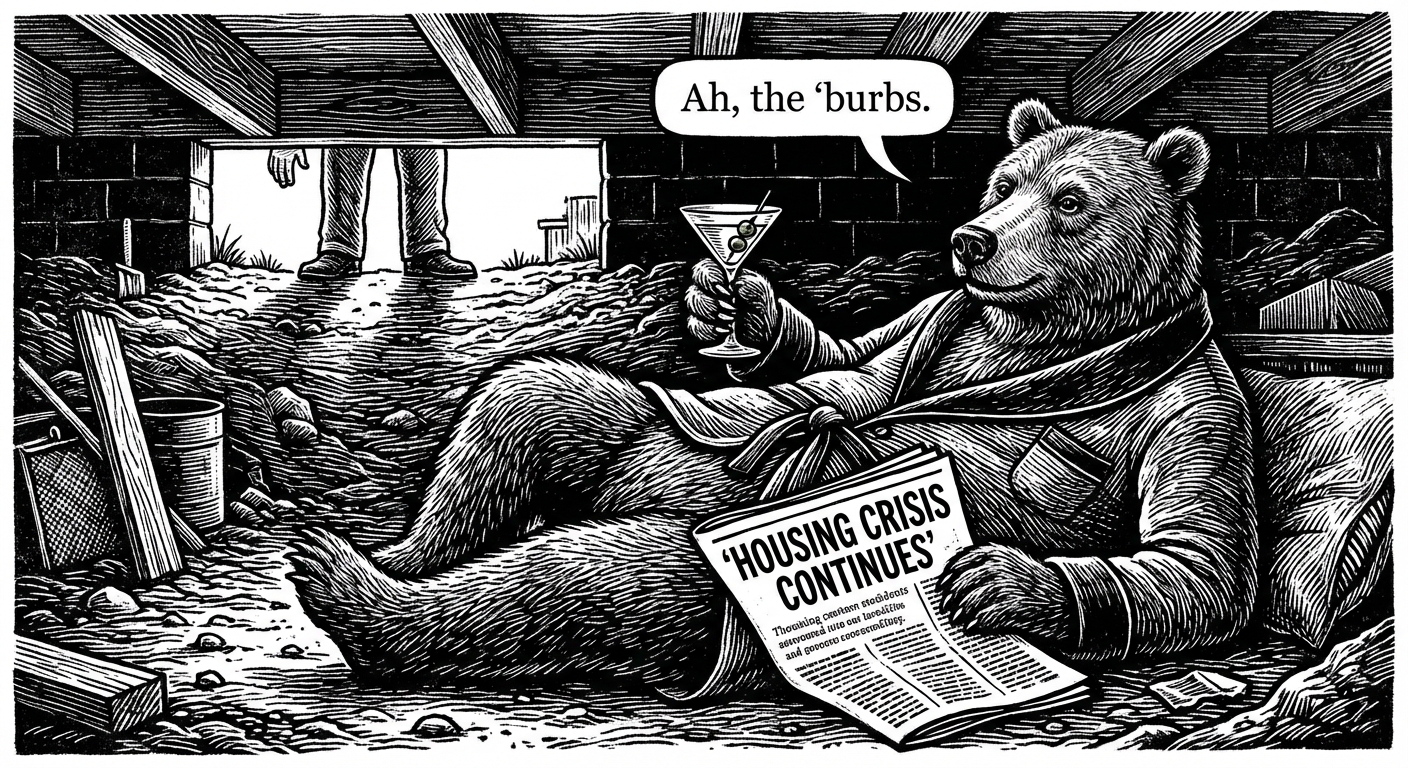
Altadena, California – the land of sunshine, avocado toast, and now, apparently, ursine squatters. Ken Johnson, a homeowner in this idyllic slice of the Golden State, recently discovered he was sharing his property with a tenant of the four-legged, clawed, and decidedly non-rent-paying variety: a 550-pound black bear [2]. This isn't some weekend visitor; this is a long-term residency situation, a furry freeloader who has apparently taken up residence under Johnson's house since Thanksgiving [2]. One wonders if he left a bad review on Yelp after finding the crawlspace to be a bit drafty.
One could argue that this is merely a case of 'finders keepers' in the wild west of California real estate. After all, adverse possession laws are quite clear: if you inhabit a property openly, notoriously, and continuously for a statutory period, you can stake your claim. Has Johnson inadvertently ceded ownership of his crawl space to Ursus americanus? Is this the beginning of a new era of bear-led property disputes?
The California Department of Fish and Wildlife (CDFW), bless their bureaucratic hearts, are reportedly 'aware' of the situation [1]. This is reassuring, in the same way that knowing the Titanic's captain was 'aware' of the iceberg provides solace to the descendants of the passengers. They have apparently been attempting to 'remove' the bear, a process that seems to involve a level of urgency usually reserved for untangling Christmas lights. The CDFW's commitment is evident [1], although one wonders if that commitment extends to covering the inevitable therapy bills Johnson will incur after sharing his home with a creature capable of mauling him in his sleep. According to one report, securing the crawlspace will be Johnson’s responsibility [2], which raises the question: Shouldn’t the CDFW offer Bear-Proofing Grants? It's only fair to subsidize the terror of the Altadena gentry.
The situation is ripe for a good old fashioned 'Man vs. Wild' narrative, with Johnson cast as the hapless suburbanite battling the untamed forces of nature [1]. But let's be honest, the real conflict here is 'Man vs. Bureaucracy,' a timeless tale of ordinary citizens facing the glacial pace and bewildering logic of government agencies. The CDFW, despite their best intentions, seem to be operating under the assumption that bears respond to reason and gentle persuasion, as if one could simply post an eviction notice on a redwood tree and expect the furry delinquent to pack his honey pots and leave.
Historically, encounters between humans and wildlife in California have been handled with a level of finesse reminiscent of a toddler playing the piano. Consider the Great Squirrel Uprising of 1978, when militant squirrels, fueled by a potent combination of acorns and anti-establishment sentiment, briefly seized control of the Bay Bridge, demanding lower bridge tolls and access to organic nut butters. Or the infamous Seagull-Gate scandal of 1992, when a flock of seagulls, allegedly bribed by disgruntled fishermen, bombarded a mayoral parade with… well, let’s just say it wasn’t confetti.
“"One wonders if the bear will start demanding avocado toast..."”
These incidents, largely forgotten by mainstream history, serve as a cautionary tale: California's wildlife is not to be trifled with. They are cunning, resourceful, and possess a deep-seated resentment towards anyone who dares to encroach upon their natural habitat. And now, with a 550-pound bear holding dominion over an Altadena crawl space, we find ourselves at a new frontier of interspecies conflict.
The BEAR League, a noble organization dedicated to the protection of bears (and presumably, the prevention of future crawl space occupations), suggests homeowners secure their crawl spaces [1]. This is sound advice, akin to suggesting one invest in flood insurance after their house has already been submerged. Perhaps the BEAR League could partner with the CDFW to offer workshops on 'Bear-Proofing Your Bungalow,' complete with demonstrations on how to install bear-resistant crawl space doors and tips on negotiating with bears on lease terms (honey as a security deposit is non-negotiable).
Meanwhile, Johnson, the unwilling landlord to this ursine tenant, is left to grapple with the potential damage to his property and the legal implications of harboring a protected species [2]. Is he liable if the bear decides to host a rave in the crawl space? Can he deduct the cost of honey from his taxes as a 'bear-related expense'? And perhaps most importantly, will his homeowner's insurance cover 'acts of God' that involve a 550-pound black bear with a penchant for interior decorating (with mud and fur, presumably)?
The absurdity of the situation is further amplified by the fact that the CDFW is, in theory, trying to lure the bear out with a trap baited with cherry and caramel scents [2]. It's unclear whether bears are particularly fond of artificial flavoring, or if this is simply a cynical attempt to appeal to the bear's inner tourist. One imagines the bear emerging from the crawl space, sniffing the air, and declaring, 'Meh, I prefer pistachio.'
Let's not forget the bear's perspective in all of this. Here is a creature, perfectly adapted to its environment, simply seeking shelter and sustenance in a world increasingly encroached upon by humans. Is it really the bear's fault that Johnson's crawl space provides a more hospitable habitat than the rapidly dwindling forests of Southern California? Perhaps Johnson should consider himself lucky; at least his tenant isn't playing loud music at 3 AM or hosting wild parties (that he knows of).
Of course, the ultimate irony is that the very policies designed to protect these magnificent creatures are now creating a situation where a homeowner is essentially held hostage in his own home by a protected species. It's a Catch-22 of epic proportions, a testament to the unintended consequences of well-intentioned legislation. The situation is so absurd, one almost expects the bear to start demanding avocado toast and posting Instagram stories from Johnson's backyard.
The media, predictably, has framed this as a straightforward case of 'Homeowner vs. Wild,' [1] conveniently ignoring the larger societal issues at play. This isn't just about a bear in a crawl space; it's about the increasing overlap between human and animal habitats, the challenges of wildlife management in a rapidly urbanizing world, and the inherent absurdity of expecting nature to conform to our neatly ordered suburban existence. The CDFW should equip bears with tiny bodycams to wear in crawlspaces. Then we'd be talking.
Ultimately, the Altadena bear saga serves as a potent reminder: in California, the only constant is change, and sometimes that change comes in the form of a 550-pound, cherry-caramel-scented squatter. And while Johnson may be understandably frustrated, perhaps he should consider the unique opportunity he's been given: a front-row seat to the ongoing drama of human-wildlife conflict in the Golden State. Plus, think of the story he'll have to tell at parties – assuming, of course, he ever feels safe enough to host one again.